


Online Advertising Rates: Guidelines and Best Practices

Online advertising rates are set through a combination of ad size, ad location, ad performance and market demand.
Optimizing this key ad sales tactic results in higher revenue, increased advertiser acquisition and increased advertiser retention.
These results in turn influence the price on the online rate card.
Although many websites use similar ad sizes, market demand in particular is a major factor with rates. Some companies can charge more because they have brand power.
For example, the 2019 rate card for U.S. News & World Report shows run of site rates for each section at a $25 CPM (cost per thousand impressions) at the 300 x 250 medium rectangle and 728 x 90 leaderboard positions. Targeted sections go for $30, $35 and $40 respectively. Geo and behavioral targeting command an extra $5 CPM. These rates are quite a bit higher than smaller media companies, such as local newspapers.
The 2021 online advertising rate card for the Economist magazine has run of site rates even higher, ranging from $40 to $62 for the 300×250 and $53 to $82 for the desktop leaderboard. Contextual rates command another 15 to 20 percent more.
The rise of responsive advertising in recent years may seem at first glance to complicate how to set online advertising rates. In reality, responsiveness is just an ad position that accommodates more than one ad size. Many sites still use a small number of ad sizes.
Average Google AdSense Rates
What does the market indicate about average online advertising rates? A poll of more than 100 voters on this site showed the following average page RPMs for Google AdSense:
- 33% of voter – up to $5
- 25% – $5 to $10
- 19% – $10 to $20
- 23% – more than $20
Google takes 32 percent of AdSense revenue, so the actual RPMs look this way:
- 33% – up to $7.35
- 25% – $7.35 to $14.70
- 19% – $14.70 to $29.40
- 23% – more than $29.40
Note that page RPMs reflect the number of advertising impressions per page.
Premium online advertising networks such as Mediavine do even better for publishers because they have access to premium advertisers.
Online Ad Size and Dimensions
The size of the ad is a major factor in online advertising rates simply because of the amount of space each one takes up on a page.
Just as broadcast sells time and print sells space, online sells pixels.
Here are the total pixels for the original three Internet Advertising Bureau sizes that dominated what used to be the universal ad package for online display advertising. Although publishers and advertisers work nowadays with many more sizes, these three serve as good examples of how space impacts rate.
- 728 x 90 – 65,520 pixels
- 300 x 250 – 75,000 pixels or 14 percent larger than the 728
- 160 x 600 – 96,000 pixels or 28 percent larger than the 300 and 47 percent larger than the 728
Based strictly on space alone, the 160 x 600 skyscraper should command the highest premium on the rate card, followed by the 300 x 250 and then the 728 x 90.
Dimensions via the ratio of height to width matter because they impact the creative. As a result, the 300 x 250 often gets the best rate and highest demand because it works better for creative, despite the larger size of the 160 x 600.
In the last few years, the 300 x 600 has become more popular (while the 160 x 600 has declined). It has the width of a 300 x 250 and the depth of a 160 x 600. At 180,000 pixels, it is 140 percent larger than the 300 x 250 and 96 percent larger than the 160 x 600.
 Loading ...
Ad Location
Ads located above the scroll perform best. Whether they also work best on the left, in the center or on the right depends in part on what else the page contains.
However, a leaderboard (728 x 90) does not perform well above the site logo. It usually performs better to the right of the logo and even better below it.
Although the skyscraper is the largest size, what is known as the pillow or rectangle — the 300 x 250 — often is seen as having a strong clickthrough rate and location when it is placed within the body of an article and the article wraps around it.
The concept of viewability — ad positions that are viewable at the top of the page without scrolling — has become more important in online advertising rates.
Advertising Performance

Size, location and the quality of the ad contribute to ad performance — in other words, the clicks.
Performance increases with targeting as well. An ad about job openings for nurses will perform well in an employment section for nurses.
But that same ad is likely to perform less well if it runs in other employment sections.
Therefore, the ad might command a premium on price in the most targeted section and a discount in other sections of a site.
Response should not depend on clicks alone. An ad with a phone number in it can result in a response via a phone call rather than a click.
In-store traffic because of a coupon ad, an ad about a sale or simple brand awareness is an invaluable form of indirect response.
Market Demand
The perception of better performance and location leads to higher market demand. For many sites, that higher demands results in a premium for their online advertising rates.
A publisher will find that setting a rate card at a level low enough to sell out the bulk of the inventory will increase retention for advertisers. It also creates the potential for aggressive rate increases in the long run.
Content sites will find that a careful balancing of the above four factors will drive higher sellout rates and advertising market share.
Guaranteed Impressions
A client might sign a contract for 20,000 impressions. But are the impressions guaranteed?
They are not if the site is oversold and runs out of them. For that reason, guaranteed impressions have greater value than non-guaranteed.
It may seem obvious that clients are guaranteed them. Whether or not to do so creates an opportunity in sales for selling guaranteed at a higher rate and non-guaranteed at a lower rate.
The simplest and most well-known example of non-guaranteed impressions is the use of remnant advertising networks such as Google AdSense. Networks allow a site to generate revenue from unsold inventory. I have also used unsold inventory to promote:
- Contact us about advertising.
- Website sections with high CPMs.
- Sections that are falling short of guaranteed impressions.
A good sales team should try to sell some of that inventory on their own as non-guaranteed impressions. The rate can be somewhere between what they get from national remnant networks and what they get from guaranteed impressions on the rate card.
The client then pays a variable amount each month based on the number of impressions delivered.
Homepage Takeovers
The 2021 online rate card for The Economist magazine has an example of a unique ad placement tactic: the homepage takeover.
A homepage takover in this case (and many others) will give an advertiser 100 percent share of voice for the homepage for a single day. That means any and all advertising space on the homepage goes to one client.
Rates are set according to each regional homepage of the publication. They range from $800 to $24,900.
Unit CPM Ad Rates
CPM is cost per thousand impressions. A review of 13 online newspaper rate cards showed the following average run-of-site (ROS), open-contract rates for the three major banner positions:
- 728 x 90: $14.88
- 300 x 250: $16.12
- 160 x 600: $15.25

Pixabay Creative Commons license
Most of the 13 newspapers charged a similar rate for each position. Many major media sites charge at least a $10 CPM and some go as high as $25-30. But those rates are declining as competition increases.
The Chicago Tribune has an automated service that charged only $10 per thousand for geo targeted ads.
A U.S. News and World Report online rate card charged a $25 CPM for run of section and $30 to $50 for high-value subsections. Interstitials command another $15 on top of the base rate. Targeting gets another $5 more.
The highly targeted Advertising Age had run-of-site CPM rates at $68, targeted sections at $68 and tagging at $90.
Targeted advertising commands a higher rate. Discounts are often available for high-volume and long-term contracts. Sites typically with the highest rates also have the steepest discounts and vice versa.
But it’s worth noting that CPM and CPC rates are declining over time as the total number of Web sites and pages is increasing faster than the amount of online advertising.
One answer to that problem: Drive up ad inventory volume by increasing site audience, unique visitors, visits and page views. Take market share from competitors.
Page CPM Rates
The average CPM rate for a page is an effective tool for an online business to measure how efficiently a Web site is performing for both revenue and audience.
Anyone who uses Google AdSense to generate extra site revenue will recognize this metric in their account reports.
To arrive at page CPM, divide total site revenue by total site page views. Then multiply the result by 1,000. The formula is simple:
Total site revenue / total site page views * 1,000 = Page CPM
A few more realistic examples will make the usefulness clear.
- Example A — Assume a medium-sized site has $5,000 in revenue and 500,000 page views in a month. The average page CPM for the site is $10 using the formula of $5,000 / 500,000 * 1,000.
- Example B — Assume a small site has $1,000 in revenue and 50,000 page views a month. The average page CPM is $20.
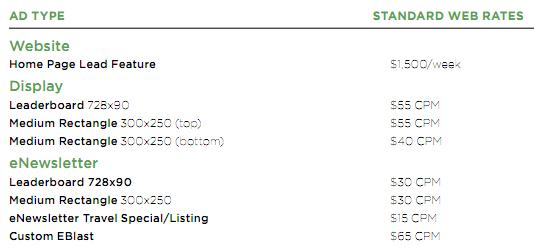
This rate card for a travel publication shows high CPMs because of its targeted audience with high income demographics.
What is a Good Page CPM?
I did two studies for clients. One revealed average page CPMs of about $12 for a group of small, underdeveloped sites. The other had CPMs ranging from $30 to $40 for another group of large and advanced sites. That group also had multiple revenue-generating products such as classifieds, directories, mobile and video.
A $12 CPM is too low for the underdeveloped sites to make a profit, while the larger sites have CPMs more in line with their true potential.
Some major national sites I analyzed have a page CPM of nearly $100. But they also have high marketing and production costs and targeting of high-value audiences.
A page CPM can be both too low and too high. A CPM that is too high can mean that a site is running the risk of selling out all available ad inventory and must focus more attention on boosting site traffic. It has pushed out low-CPM inventory. Good news can be a mixed blessing.
Although there is no perfect number, page CPM is a useful metric in striking a balance between revenue and audience performance.
If average CPMs are declining, one way to make up the difference is by increasing the volume of impressions. This is usually done by taking audience market share away from other sites in an environment where online audience growth rates are slowing.
CPC Rates
An advertiser who uses Google AdWords, Facebook, Bing or other major advertising sites will instead likely pay based on a cost per click or CPC.

A CPC rate card is fair to an advertiser based strictly on response rates, but it is unfair to the publisher if a great deal of inventory is used for a poor ad that generates no response.
As a result, a CPC campaign can have a wildly unpredictable cost and benefit.
It becomes even more unpredictable based on the category. Auto, real estate and employment have a high CPC for advertisers because of intense competition for inventory. A $4 CPC for real estate could result in a $20,000 commission for a Realtor and broker.
So a CPM campaign should be judged based on impressions with an emphasis on branding and response. A CPC campaign should be judged based on conversion rates.
Impact of CPC on CPM
Some studies are showing that cost per click advertising is driving down CPMs.
In fact, some buyers of search engine advertising are finding that when CPC is calculated on a CPM basis, the rate is closer to $2 to $3.
CPC delivers superior performance at lower rates if done right. As a result, the advertiser benefits, but the publisher often does not.
Targeted Versus Run of Site
Yet another factor that impacts online ad rates is whether the campaign targets a specific section or is run-of-site.
An ROS campaign means the ad runs in any section or page on the site where inventory is available. They work best with campaigns that appeal to large sections of the general public.
Those ads show up most often in sections that have low demand by other advertisers. For that reason, they command a lower CPM or CPC.
Campaigns that target a specific section or topic work best for advertisers who want to reach a niche audience. Examples include real estate, automotive and employment. For that reason, they command a higher CPM or CPC.
Going Off Rate Cards
Advertisers should understand that online advertising rates are not always set in stone. Whether or not a publisher will sign a contract with lower rates depends on many factors. They include the economy, the publisher’s current financial situation and the size or uniqueness of the advertising deal.
Likewise, publishers must recognize that online rate cards are fluid because the online advertising environment is fluid — and highly competitive. Unsold inventory is useless except for filler ads that may offer a much lower CPM or CPC.
 Promise Media offers online business tips and best practices for content-rich websites.
April 3rd, 2014 at 8:17 pm
Lots of interesting data here, but it is unclear when this was written…other than January 18. If this is current data, you reference studies done on behalf of clients that show an interesting disparity on rates by size of site – all else being equal. Can you share more?
April 23rd, 2014 at 9:18 am
The rate cards and studies are a bit worn, but I’m surprised at the number of sites that are still trying to charge above a $10 cpm. I know some of them go off rate card depending on the situation.
I agree that there is a disparity based on the site of the site. Other factors that contribute to the disparities include the amount of competition for each site and how deeply they specialize in a particular topic or geographic location.
November 28th, 2014 at 3:26 pm
468 X 60 seems to command the least rate.
December 3rd, 2014 at 9:04 am
Agreed. I rarely see it anymore. I think it still has some use in layouts where the space doesn’t allow anything wider or deeper. But no one should expect to make much money from it.
February 20th, 2016 at 3:22 am
Hi,
Thank you for the comprehensive article, really helped me understand things well.
Just wanted to know if one has to charge for static ads independent of CPM then what should be the monthly charge n general?
Any help would be highly appreciated.
February 23rd, 2016 at 11:06 am
You could build a sponsorship model based on CPM. For example, you might charge $100 a month for a static ad in a section on your site. If the section averages 10,000 page views a month, then $100 is a reasonable rate because it averages a $10 CPM.
But if you charge $1,000 a month, the CPM jumps up to $100, which is not reasonable.
A flat rate for a static ad doesn’t have to be exactly based on the page views or keep changing as page views drift up or down over a few weeks or a few months. But it’s a good idea to review the pricing every three to six months as site audience changes.
You don’t want to charge too little and end up with a 50 cent CPM (this actually happened to one site) or too much, which results in an unhappy customers who overpays for results.
December 21st, 2018 at 12:49 pm
One of the best analysis done on advertising cost. my only suggestion is that you should update some of your data and costs cause it seems things have moved up a little bit.
Determining advertising cost is never easy but am grateful you have taken your time to explain it here most on the banner sizes and CPM costing models.
Keep the good work up!!
December 27th, 2018 at 10:00 am
Thanks for the feedback, Eugene. I’m curious where you are seeing a move up in costs. I have found that Google and Facebook are more expensive, while other sites are seeing a downward drift.
February 2nd, 2019 at 11:52 am
My forte is journalism, not advertising. But such jobs are scarce, especially if I need to stay in the geographic area. So I came up with an idea for an online newsletter/website focusing on the business community in a particular small town in Florida. The idea is I would write the content and charge local businesses to advertise. After reading this article with CPM and CPC, I am confused on how to proceed. Any suggestions?
February 5th, 2019 at 11:42 am
Selling sponsorships is one way to get started if you are more comfortable with journalism than advertising. With a sponsorship model, you would charge advertisers a flat rate each month instead of charging them based on cost per thousand impressions (CPM) or cost per click (CPC).
For example, I know of some sites that charge a flat rate of $X per month for 20 to 40 advertisers who all rotate on the right column of the website. They charge a high rate for a single advertiser who appears on the top of the page.
You need to make sure that each advertiser rotates and gets the same number of impressions or appearances on the page if you plan to charge them the same amount.
March 24th, 2020 at 4:29 pm
Nice list of ad networks. I want to mention that Popads,Media.net and Infolinks works best for me while Bidvertiser, Chitika and RevenueHits are bad for Indian Traffic.