Searching for sample online rate cards is no easy task, but once found, the comparisons are revealing about advertising strategy and pricing.
The following rate cards have been posted on their respective Web sites for public access. It is important to note that they are subject to change at any time, so timestamps are provided when available.
Timestamp: September 2014
http://advertising.bbcworldwide.com/docs/ratecards/bbc-advertising-digital-ratecard-september-2014.pdf?sfvrsn=18
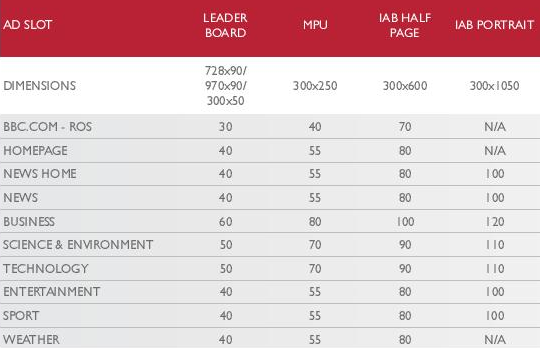
BBC.com has leaderboard positions available ranging from 970×90 and 728×90 on desktops to 300×50 for mobile.
Leaderboard rates start at a $30 CPM for run of site and range from $40 to $60 for section targeting. It is interesting to note that the rates are the same regardless of size. (All rates are in U.S. dollars.)
The Mid Page Unit or MPU, otherwise known as the box, pillow or rectangle, starts at a higher $40 and jumps as high as $100 for section targeting.
On the 300×600 in the example from the BBC.com site, notice that a 140 percent increase in size only results in rate increases of less than 50 percent.
Are two 300×250 ad positions better than a single 300×600? The answer is yes, but only if they can be sold.
Timestamp: October 2014
http://www.adweek.com/files/2014-Digital-Rate-Card-101414.pdf
Adweek has a clean and simple rate card that should appeal to advertisers because of its layout and format.
Run of site rates are $65 for the 728×90, $65 for the 300×250 and $90 for the 300×600.
The rates for rich media, video pre-roll and targeted sections including the home page jump to $100 per thousand impressions.
The pricing strategy changes to flat rates — basically a sponsorship approach — with takeovers and point of entry roadblocks. Pricing is per-day and goes as high as $44,000.
Channel sponsorships have weekly rates ranging from $7,500 to $40,000.
Timestamp: unavailable
http://www.ottawacitizen.com/about-ottawa-citizen/advertising/specs/rate-card.html
Unlike national media sites like BBC.com and Adweek.com, local media sites generally have much lower rates.
The Ottawa Citizen, a large metropolitan newspaper, has online rates similar to many online papers in the U.S. and Canada.
A run of site leaderboard or a 160×600 skyscraper starts at a $16 CPM and increases to $20 when targeting a section.
The 300×250 MPU is somewhat higher — again like many sites because of its creative-friendly size — and starts at $24 ROS and $30 targeted.
While its rates are lower than BBC and Adweek, it does share one trait in common with them: It offers numerous forms of online advertising that go well beyond the simple banner.
Timestamp: unavailable
http://www.locusmag.com/Home/LocusOnlineRates.html
Small media sites that represent magazines, newspapers, radio stations or TV stations often prefer a simple sponsorship model than one focusing on CPMs.
The upside to a pure sponsorship model is that it’s easy for the rep to explain and easy for the advertiser to understand.
The downside is that pure sponsorship pricing can end up undervaluing or overvaluing an ad position depending on audience reach.
LocusMag.com is an online science fiction magazine that claims 70,000 unique visitors a month.
Their rates show a substantial premium for key ad positions, but the audience is exceptionally targeted and often represents a demographic with high average incomes.
A Google Ads strategy for beginners begins with defining a few simple goals. Knowing these…
A Google ad strategy is an inexpensive, efficient and highly educational way of driving targeted…
The analytics bounce rate is an excellent way to measure the quality of a website…
Keyword density is an SEO tactic that suggests how many times a particular keyword should…
Forum link building is a marketing tactic that has some moderate benefits with search engine…
Website publishers who track new versus returning visitors will find new ways to increase site…