DuckDuckGo is starting to quack a lot louder at Google and Bing in the search engine market.
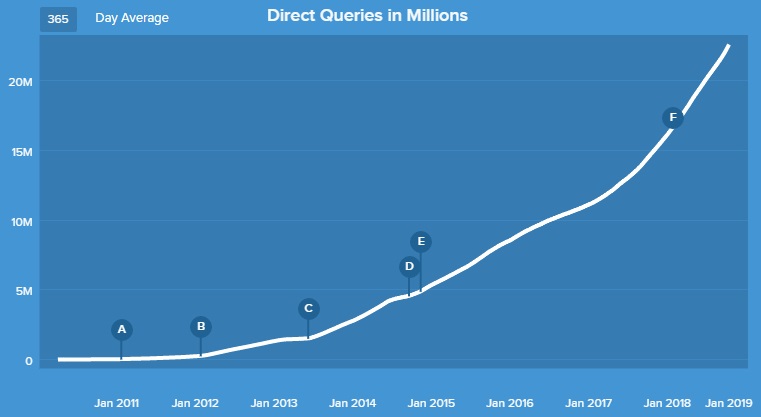
The privacy-focused search engine, which launched in 2008, recently announced it reached a new milestone of 30 million queries a day, according to its Twitter account.
That total is only 1 percent of the more than 3 billion searches per day at Google (depending on which number you believe). A comparable number for Bing is hard to find, but various sources indicate it has anywhere from one tenth to one fourth of Google.
What makes the DuckDuckGo achievement more noteworthy is the growth rate.
“DuckDuckGo fun fact: it took us seven years to reach 10 million private searches in one day, then another two years to hit 20 million, and now less than a year later we’re at 30 million!” it says on its Twitter account.
A jump from 20 million to 30 million is a growth rate of 50 percent in, as DDG claims, in less than a year. It’s an impressive growth rate in a search engine market that is largely mature in audience penetration.
Why is the growth accelerating? Maybe because of the growing hacks of personal data at Google, Facebook and other Internet giants. Maybe it’s also because DuckDuckGo proudly claims it doesn’t collect personal data.
“Our app and browser extension stop you from being tracked, so you can Internet with peace of mind,” the company says.
The site say it gets its listings from more than 400 different sources including Bing and Yahoo!
Tracking analytics is the first step in watching any impact from DuckDuckGo.
Sites where I have access to analytics show it makes up about 1 percent of the total site audience. It has pulled ahead of AOL search and shows a steady growth rate in recent months.
In some cases the traffic is equal to Yahoo!, and in others it is well behind the fading Internet giant.
Assuming it keeps growing at a strong pace, the next step is search engine optimization. DDG doesn’t offer much insight about what to do except for the following:
“Ranking is a bit opaque and difficult to discern/communicate on an individual query basis because of all the various factors involved (and which change frequently).
“Nevertheless, the best way to get good rankings (in pretty much all search engines) is to get links from high quality sites.”
That tip indicates a website publisher doesn’t need to do much differently than with standard SEO for all search engines.
A Google Ads strategy for beginners begins with defining a few simple goals. Knowing these…
A Google ad strategy is an inexpensive, efficient and highly educational way of driving targeted…
The analytics bounce rate is an excellent way to measure the quality of a website…
Keyword density is an SEO tactic that suggests how many times a particular keyword should…
Forum link building is a marketing tactic that has some moderate benefits with search engine…
Website publishers who track new versus returning visitors will find new ways to increase site…